

Jak Petzold
LSSSE Research Analyst

LSSSE’s 2025 annual report Disability in Law School represents possibly the first comprehensive look at the needs, challenges, and successes of law students with disabilities. In this post, we will explore the prevalence and type of conditions among disabled law students, a relatively large segment of the law student population that has received surprisingly little attention in legal education research.
As conversations about diversity in legal education increasingly expand beyond race, gender, and socioeconomic background, disability remains comparatively underexamined. Yet disability is deeply intertwined with how students experience the classroom, interact with faculty and peers, and navigate the demands of law school. Understanding who law students with disabilities are and the range of conditions they report is an essential starting point. Without this, it is difficult for institutions to assess whether their policies, pedagogy, and support systems are sufficient to support these students.
DEFINING DISABILITY
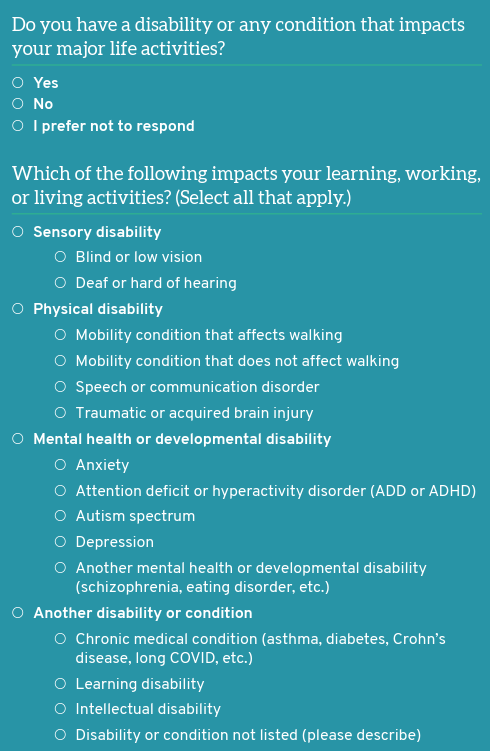
To identify students with disabilities, the LSSSE survey uses a two-step approach. First, students are asked whether they have a disability or any condition that impacts their major life activities. Those who answer “yes” are then presented with a list of specific conditions and asked to select all that apply to them. It is worth noting that this method may undercount students with disabilities as some students may not personally identify as disabled (despite having anxiety, ADHD, etc.) and therefore select “no” on the initial screening question, preventing them from reporting a condition.
PREVALENCE AND TYPE OF DISABILITIES
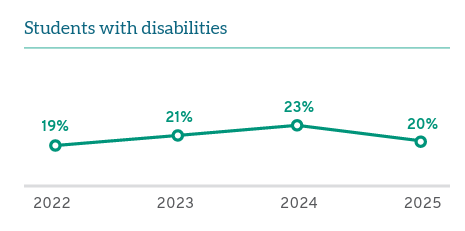
LSSSE data reveal that roughly 20% of all law students have a disability or condition that impacts their major life activities. This number has remained fairly steady since LSSSE began asking about disability in 2022, ranging from 19% in 2022 to 23% in 2024.
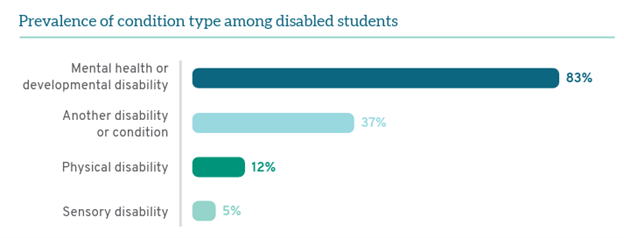
Among the population of students with disabilities, the vast majority (83%) have at least one mental health condition or developmental disability. Over one-third (37%) have a chronic condition (such as asthma, diabetes, or Crohn’s disease), a learning disability, or some condition not listed. While 12% of disabled students have a physical disability, roughly one in twenty (5.2%) have a sensory disability. Many students report more than one type of disability, so these categories overlap.
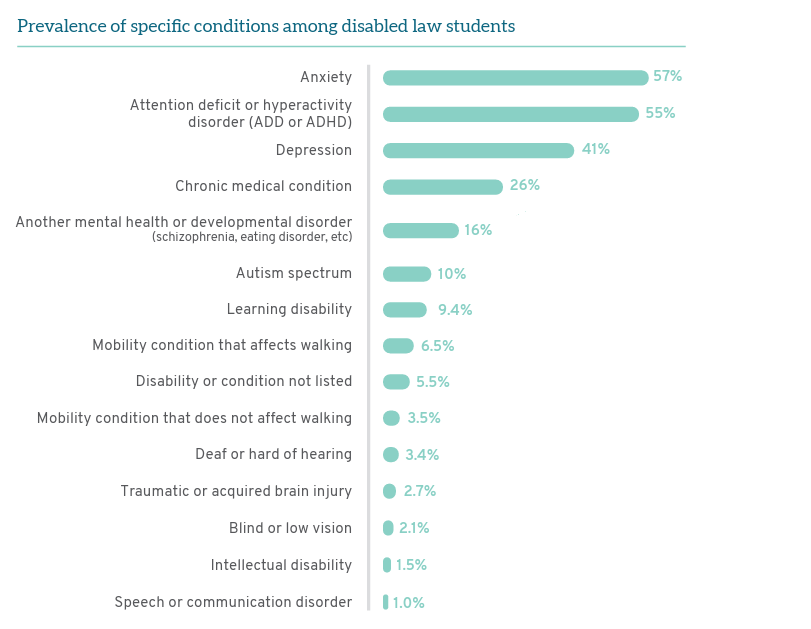
The specific disabilities reported by law students are wide-ranging, reflecting both visible and invisible conditions that shape students’ daily experiences. Among students with disabilities, mental health and developmental disabilities are the most commonly reported conditions: 57% of disabled students have anxiety, 55% have ADD or ADHD, and 41% have depression. These findings highlight how mental health shapes the day-to-day reality for a significant portion of law students with disabilities. Other conditions, while less common, are also present across the disabled law student population. Autism spectrum disorders (10%), learning disabilities (9.4%), and mobility conditions that affect walking (6.5%) each represent notable shares of disabled respondents. Students also report hearing and vision impairments, chronic medical conditions, brain injuries, and speech or communication disorders, demonstrating the broad spectrum of disability represented in legal education.
Taken together, these data make clear that disability is not a marginal issue affecting only a small subset of students. One in five law students reports a condition that substantially affects major life activities. The breadth of conditions—and the frequency with which students report multiple disabilities—suggest that disability intersects with many aspects of the law school experience, sometimes in ways that are not immediately obvious.
In our next installment of this two-part series on the Disability in Law School annual report, we turn from demographics to experience. We will examine how students with disabilities engage academically and what forms of institutional support their law schools provide, highlighting how law schools can more fully embrace disability as a meaningful and enriching part of their communities.