

Jak Petzold
LSSSE Research Analyst

LSSSE engagement indicators are composite scores that offer snapshots into key areas of the law student experience. The Student-Faculty Interaction (SFI) engagement indicator combines responses to six questions that capture the frequency and quality of students’ interactions with faculty members, from discussing assignments and career plans to receiving feedback and communicating by email.
Student-faculty interaction is a critical component of legal education. Faculty members help students develop substantive knowledge, professional identity, and career aspirations. Meaningful engagement with faculty can also strengthen students’ sense of belonging and connection to their law school community.
Looking at responses by class year reveals that student-faculty interaction is not static. Instead, the nature of these interactions shifts as students progress through law school.
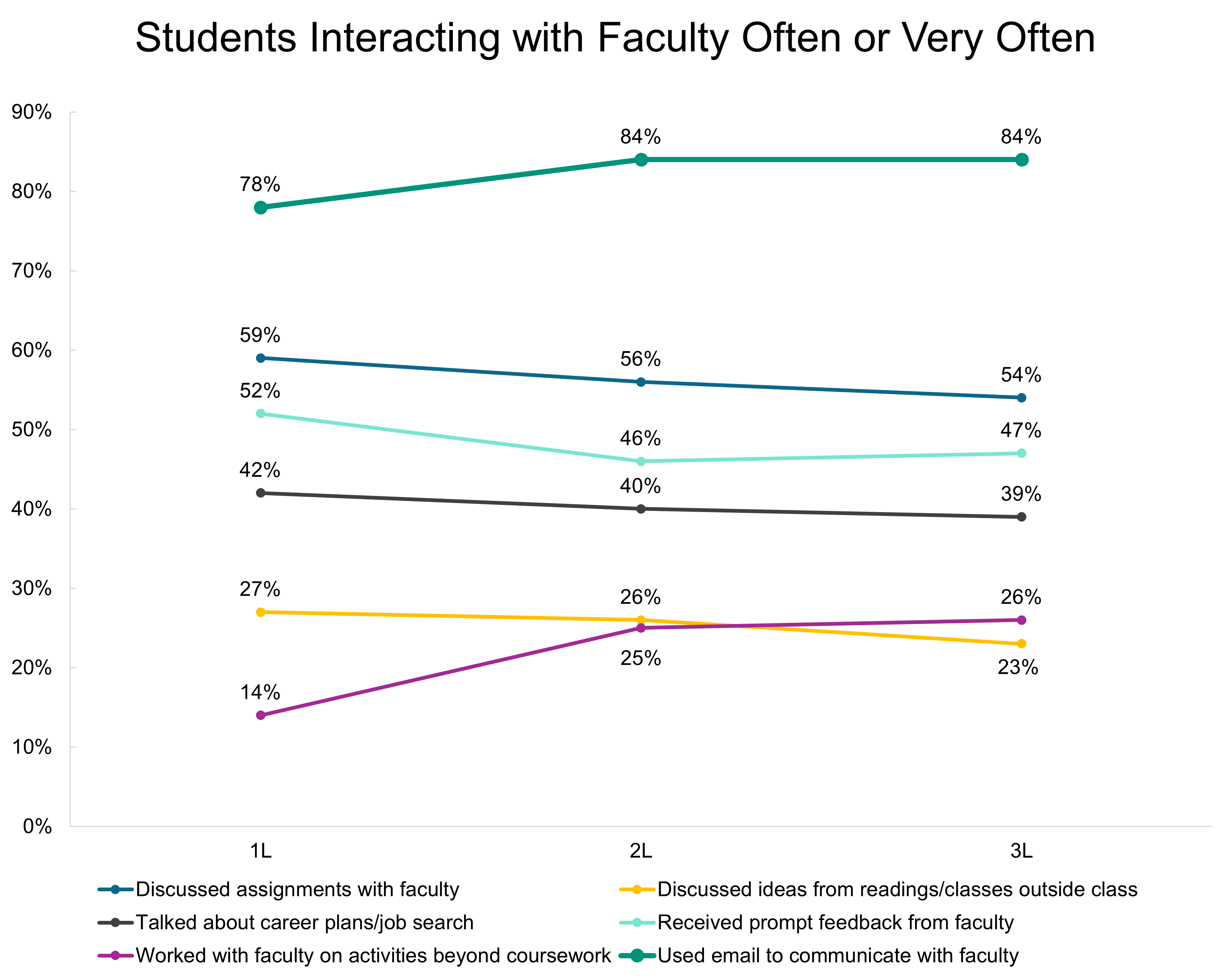
The most universal form of interaction is communication by email. Virtually all students report communicating with faculty electronically, and the frequency of these interactions increases after the first year. While 78% of 1Ls report emailing faculty often or very often, that figure rises to 84% among both 2Ls and 3Ls. Email appears to be an increasingly important mechanism for maintaining faculty connections as students move through law school.
Some forms of interaction remain remarkably consistent across class years. Discussions about career plans are common throughout law school, with approximately nine in ten students reporting at least some interaction with a faculty member or advisor on career matters. Likewise, more than 90% of students report receiving prompt feedback from faculty, regardless of class year.
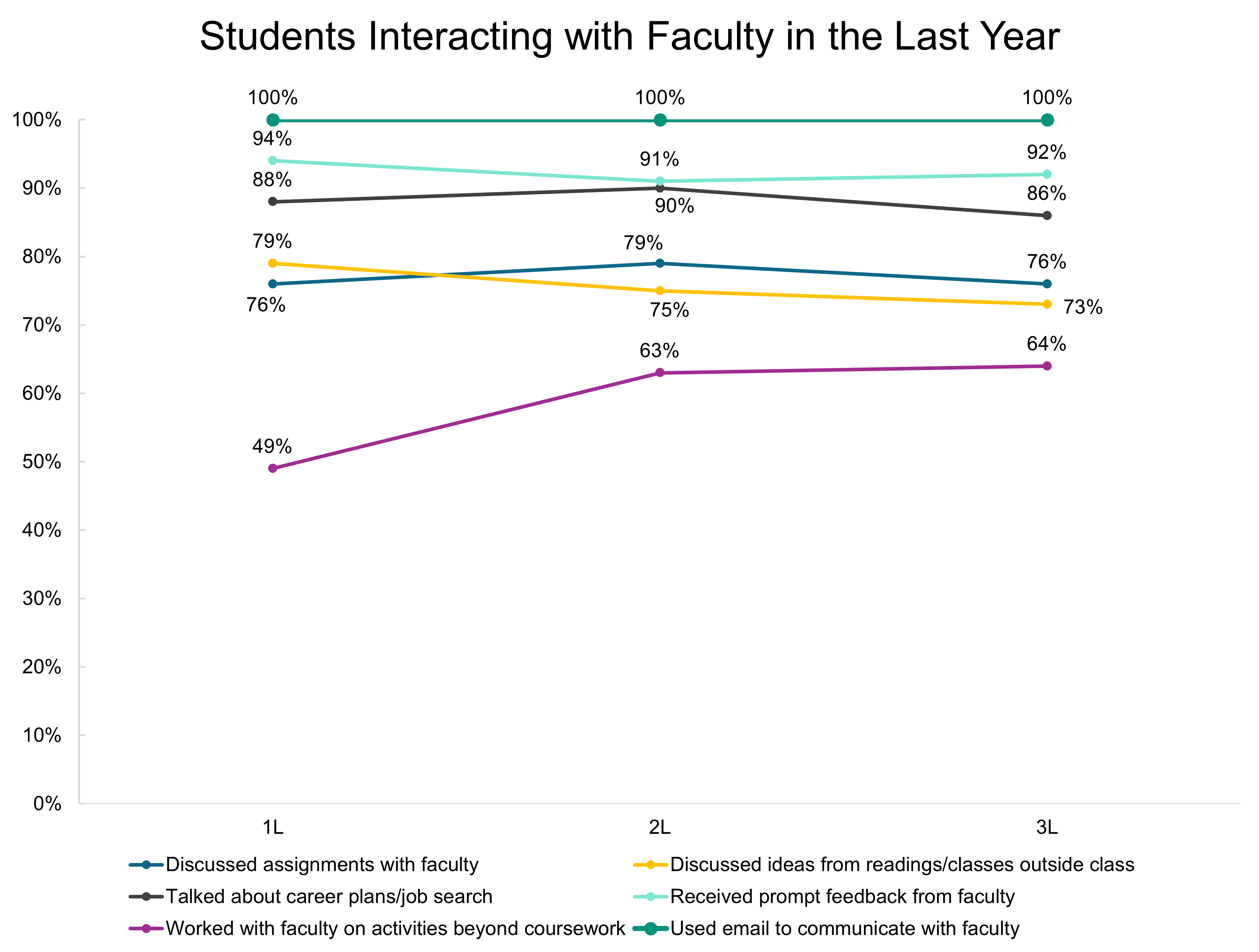
Other interactions show a different pattern. Conversations about assignments and discussions of ideas from readings or classes tend to be most common during the first year. For example, 59% of 1Ls discuss assignments with faculty often or very often, compared with 54% of 3Ls. Similarly, 27% of 1Ls frequently discuss ideas from classes with faculty outside the classroom, compared with 23% of 3Ls. These findings suggest that academically focused faculty interactions may be particularly important during students’ transition into legal education.
In contrast, collaboration with faculty outside the classroom becomes substantially more common over time. Only 49% of 1Ls report any involvement with faculty on activities such as committees, orientation programs, or student life initiatives. By the third year, that figure rises to 64%. The percentage who engage in these activities often or very often nearly doubles, increasing from 14% among 1Ls to 26% among 3Ls. As students gain experience and become more integrated into the law school community, opportunities for faculty collaboration appear to expand.
Taken together, these findings illustrate how student-faculty interaction changes across the law school journey. Early interactions are more likely to center on coursework and academic support, while later interactions increasingly reflect mentorship, collaboration, and professional development. Both forms of engagement contribute to a richer and more connected law school experience.