

April 20, 2025
Jerry Organ
Bakken Professor of Law and Co-Director of the Holloran Center for Ethical Leadership in the Professions at the University of St. Thomas School of Law

The 2021 Survey of Law Student Well-Being (2021 SLSWB) was administered in spring of 2021, seven years after the initial 2014 Survey of Law Student Well-Being (2014 SLSWB). While there were 15 participating law schools in the 2014 SLSWB with over 3000 respondents, there were 39 participating law schools in the 2021 SLSWB with over 5500 respondents.
The 2021 SLSWB retained many of the questions that were in the 2014 SLSWB to provide a temporal comparison, but the 2021 SLSWB also included a new set of questions on the extent to which respondents had experienced trauma. This was the first time in which there was a multi-school study that explored the trauma experiences of law students. My co-investigators and I have summarized many of the comparative results along with a brief description of the trauma results in an article in the Louisville Law Review entitled: “It’s Okay Not to Be Okay” – The 2021 Survey of Law Student Well-Being.[1] In addition, the National Report for the 2021 SLSWB, which contains the aggregated responses to the trauma questions, can be found in the AccessLex Resource Collections.[2]
Over the last two years, we have had opportunities to present some of the trauma data at the International Academy of Law and Mental Health Congress in Barcelona and more recently at the Law and Society Conference in Chicago.
The trauma questions in the 2021 SLSWB identified 15 categories of traumatic experiences, including vicarious trauma and “other” trauma (with an option for the respondents to describe the experience). Over 80% of respondents indicated that they had some type of traumatic experience, with over 50% having four or more traumatic experiences.[3] Women/Other were more likely than men to have experienced trauma and more likely than men to have experienced trauma four or more times.[4] Of those who experienced trauma, roughly 40% experienced some traumatic event during law school.[5]
Those who answered yes to one or more trauma categories were then asked to complete the PCL-5, a self-report instrument used to screen for PTSD which consists of twenty items associated with the diagnostic criteria set forth by the Diagnostic and Statistical Manual of Mental Disorders-Fifth Edition (DSM-5) for PTSD.[6] Respondents rate on a five-point Likert scale (zero meaning not at all to five meaning extremely) how often they have been bothered by a particular symptom of PTSD, with scores of thirty-one to thirty-three representing the most common scoring range used to identify those who may benefit from having a PTSD evaluation.[7] Using the more conservative threshold of 33, 26.3% of respondents who experienced trauma met or exceeded a score of 33 on the PCL-5, which means roughly one in five respondents to the survey would benefit from being assessed for PTSD.[8]
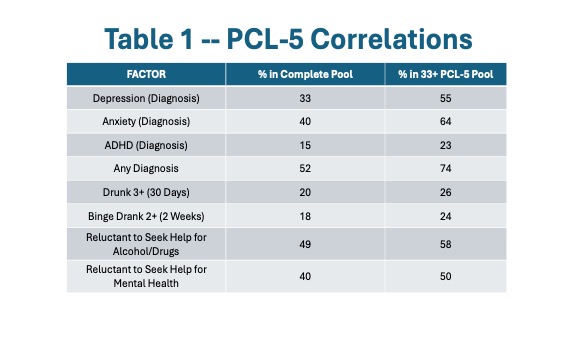
Notably, as presented in Table 1, those respondents with a score of 33 or more on the PCL-5 also were much more likely than other respondents to experience substance use or mental health challenges and were less inclined to seek help for those challenges.
 When these results are viewed in light of recent data from the LSSSE’s module on Stress and Anxiety, one can imagine that law students dealing with trauma are experiencing even more stress and anxiety than the average law student.
At last year’s Law and Society Conference in Chicago, Jak Petzold, Research Analyst with LSSSE, presented some of the data from the Stress and Anxiety Module that was implemented in conjunction with the 2023 and 2024 administrations of the LSSSE.[9] The data showed that on a seven-point Likert scale, 78% of respondents were at a five or above in describing their experience of stress and anxiety in law school, with academic concerns (nearly 80%) and job/financial concerns (roughly 50%) being most prevalent.[10] Roughly half indicated that stress or anxiety impacted their law school performance “quite a bit” or “very much.”[11]
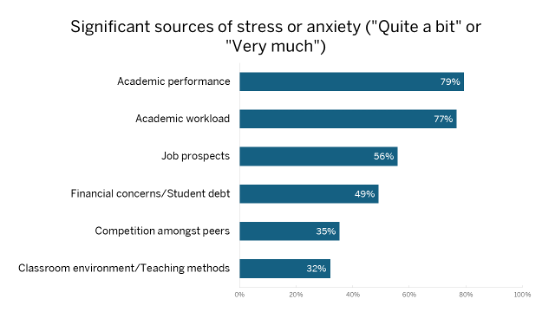
Notably, fewer than 25% indicated that their law school does “quite a bit” or “very much” in emphasizing ways to manage anxiety and stress effectively.[12] In addition, while respondents engaged in some positive coping strategies such as exercise (77%), talking with friends or family members (75%), engaging in a hobby (53%), positive self-talk (44%), or counseling/therapy (33%), some also engaged in negative coping strategies such as procrastination (57%), negative self-talk (27%), or alcohol/drugs (27%).[13]
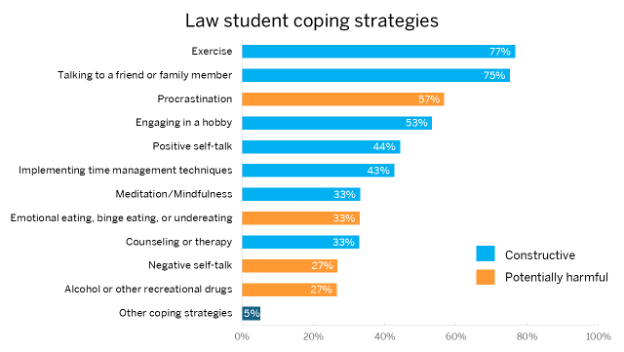
These LSSSE data show that law schools generally are not doing enough to emphasize to their law students ways to manage anxiety and stress more effectively. Similarly, as law schools are just beginning to digest the 2021 SLSWB data on the scope of law student experiences with trauma, it is likely safe to say that law schools are not doing enough to help their students who are affected by experiences of trauma to navigate the added stress and anxiety that they likely are experiencing in law school.
Law schools need to do more to help all law students, but particularly those law students dealing with trauma in some way, to develop the tools they need to engage more productively in managing the stress and anxiety of law school and to prepare them for the stress and anxiety of practice.
[1] David Jaffe, Katherine Bender, Jerome M. Organ, “It’s Okay Not to Be Okay”: The 2021 Survey of Law Student Well-Being, 60 U. Louisville L. Rev. 441, 467-68 (2021).
[2] 2021 SLSWB National Report, available at https://arc.accesslex.org/grantee/99/.
[3]See Jerome M. Organ, Presentation at IALMH Congress, Law Students and Trauma – Data from the 2021 Survey of Law Student Well-Being, July 25, 2024. (PowerPoint slide deck on file with author.)
[4]Id.
[5]Id.
[6]See F.W. Weathers et al., The PTSD Checklist for DSM-5 (PCL-5), U.S. DEP’T VETERANS AFFS. (2013), https://www.ptsd.va.gov/professional/assessment/adult-sr/ptsd-checklist.asp [https://perma.cc/4H4N-7AGE].
[7]Id. (describing the scoring process).
[8]See Jaffe, et al., supra note 1 at 468.
[9] Jak Pretzold, Presentation at Law and Society Conference, Law Student Stress and Coping Strategies (May 2025)(PowerPoint slide deck on file with author.)
[10]Id.
[11]Id.
[12]Id.
[13]Id.