

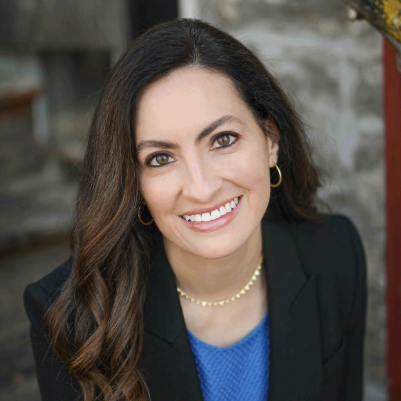
Rebecca Scheller
Chief Administrative Officer and Associate Dean for Admissions & Financial Aid at the University of Wisconsin Law School
When I sat down with Meera Deo in Chicago last month, I found myself telling her something I don't say often enough out loud: the data LSSSE and SELFS produce has become one of the most powerful tools at the University of Wisconsin Law School — not because it's flashy or always flattering, but because it turns "I have a feeling that..." into "here is what our students, faculty, and staff are actually telling us, compared to what's happening at law schools across the country."
That distinction matters in administrative conversations. "Morale seems low" competes with a dozen other reasonable-sounding priorities; a specific, benchmarked number is much harder to wave away — and it's no accident that some of our sharpest LSSSE and SELFS findings map directly onto our
Where the numbers surprised us
LSSSE's national percentile benchmarking is what makes the student data useful, not just interesting — it informs both our reflections on where we stand and our decisions on where we want to be. Looking at our Student/Faculty Interaction results against the 2025 LSSSE cohort, a pattern jumped out: across nearly every item — email with faculty, discussing assignments, talking through career paths with an advisor, working with faculty on research outside class, sitting on a student-faculty committee — our results landed in the bottom 10 to 25 percent nationally. Not one or two data points, but a consistent pattern across the category.
That pattern is a big part of why Strategic Priority 3 — Strengthen the Law School Community — includes Initiative 3.1: strengthening professional support and career guidance through alumni connections and other relationship-building opportunities. That's not a vague culture problem — it's a measurable interaction gap, and it pointed us toward a concrete lever: build structured relationship-building into the student experience, backed by real commitment and resources, rather than leaving it to chance.
What a decade of investment in financial aid counseling delivered
Not every finding was a gap to close. Some of our strongest LSSSE results validated a bet we made roughly a decade ago, when we doubled down on staffing for financial aid support. Today we have three staff members with at least a portion of their portfolios dedicated to financial aid counseling, plus a Financial Wellness series covering loan repayment, budgeting, credit, and taxes, with one-on-one coaching from an Accredited Financial Counselor — robust enough that students can now earn a Financial Wellness Fellow designation for regular attendance.
The data back that investment up: on LSSSE's Student Services Report, our satisfaction scores for financial aid advising and loan counseling both land in the top 25 percent nationally, and among 1Ls specifically, advising satisfaction ranks in the top 10 percent — a direct return on a staffing decision made a decade before we had the benchmark to prove it out.
That result speaks to Strategic Priority 2 — Expand Access to Legal Education — and Initiative 2.3 specifically, which calls for securing resources for need-based financial support and helping students navigate loan systems. We already have the staffing and programming that initiative describes, with years of data showing it works, and we're now in a position other schools ask us about directly: we've become something of a model for financial aid support nationally, and we can point to exactly why. At a moment when the value of a legal education is front and center in public discourse, that matters: we've kept our students' debt manageable and kept them informed along the way, and our LSSSE results are the validation, not just our own impression.
What SELFS added that we didn't have before
The student side of the story was only half of it. SELFS — LSSSE's newer survey of law faculty and staff — gave us a view we'd genuinely never had in a comparable, benchmarked form.
Faculty responses were, on balance, reassuring: 100 percent reported being satisfied and rewarded by their work, and 87 percent agreed the demands and workload here are manageable. Faculty also reported high regard for staff, students, and school leadership across the board.
Faculty Satisfaction
University of Wisconsin Vs. National Average

Demands of Workload are Manageable
University of Wisconsin Vs. National Average

But the most useful finding wasn't the reassuring one — it was the gap between two mirror-image questions. Eighty-six percent of our faculty agreed that "faculty at my law school respect the administrative staff." Asked "I feel respected by faculty," only 54 percent of our student-facing staff agreed, well below the 75 percent national figure. Faculty believed they were extending respect a majority of staff weren't experiencing.
That's the kind of finding a survey is built to surface and a hallway conversation never would — and it's precisely the gap Priority 3 is built to close, through Initiative 3.3 (professional development for faculty and staff) and Initiative 3.4 (faculty-staff collaboration on our shared mission). Without the SELFS data, those initiatives could have stayed well-intentioned sentiments. With it, we have a measurable starting point and a way to check, years from now, whether it has closed.
Why this kind of data changes the conversation
What I've come to value most about LSSSE and SELFS isn't any single number — it's that the data forces precision. It's much harder to dismiss "54 percent of our staff feel respected by faculty, against a 75 percent national benchmark" than a general sense that morale could be better. National comparison data tell you not just that something is true, but whether it's true here in a way that's unusual, or an industry-wide condition every school is managing.
For those of us doing strategic planning, budget advocacy with central campus, or human resources work at a law school, that specificity is the whole game — the difference between a plan built on instinct and one to which you can hold yourself accountable. If your school is weighing whether to join LSSSE or add SELFS, that's worth it alone: you'll walk away with language the dean’s entire leadership team can point to and tools to help build actionable results — a law school experience and working environment that supports students, faculty, and staff alike, and allows us to spend less time guessing and more time doing what we're actually here for: educating exceptional lawyers and advancing equal justice under law.