

Jak Petzold
LSSSE Research Analyst

Although around 20% of law students have at least one disability or condition that affects their major life activities, fairly little attention has been given to their experiences in law school. In our previous post, we shared some insights about the characteristics of law students with disabilities that were described in our 2025 LSSSE annual report Disability in Law School. In this post, we will show that although law students with disabilities are energetically engaged with both the core and extracurricular activities of law school, they are less satisfied and feel less supported than their non-disabled peers. These findings highlight important gaps between participation and experience that deserve closer attention from law schools. Understanding where and why these differences emerge is a critical step toward creating a more inclusive and supportive legal education environment.
Academic Engagement
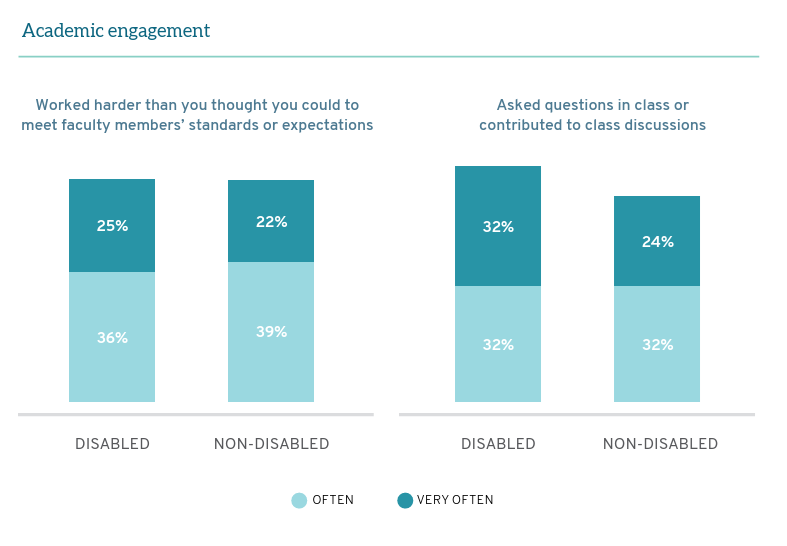
Students with disabilities play an active role in the law school community. Disabled and non-disabled students are equally likely to report that they have frequently (“often” or “very often”) pushed themselves to meet faculty expectations (61%). In fact, disabled students are slightly more likely to say they have done so “very often” (25% compared to 22% for non-disabled students), suggesting a high level of motivation. Disabled students also participate more actively in class: 65% of disabled students report frequently asking questions or contributing to discussions, compared to 57% of nondisabled students. This difference is driven in part by the intensity of their engagement— nearly a third of disabled students (32%) participate “very often,” versus just one quarter (24%) of their non-disabled peers.
High levels of classroom involvement may be tied to the additional time they devote to preparation. On average, students with disabilities spend nearly an hour and a half more per week preparing for class than students without disabilities (28.6 hours vs. 27.2 hours). This intense preparation and participation reflect a strong commitment to succeeding in an academic system may not have been designed with them in mind.
 Co-Curricular Activities
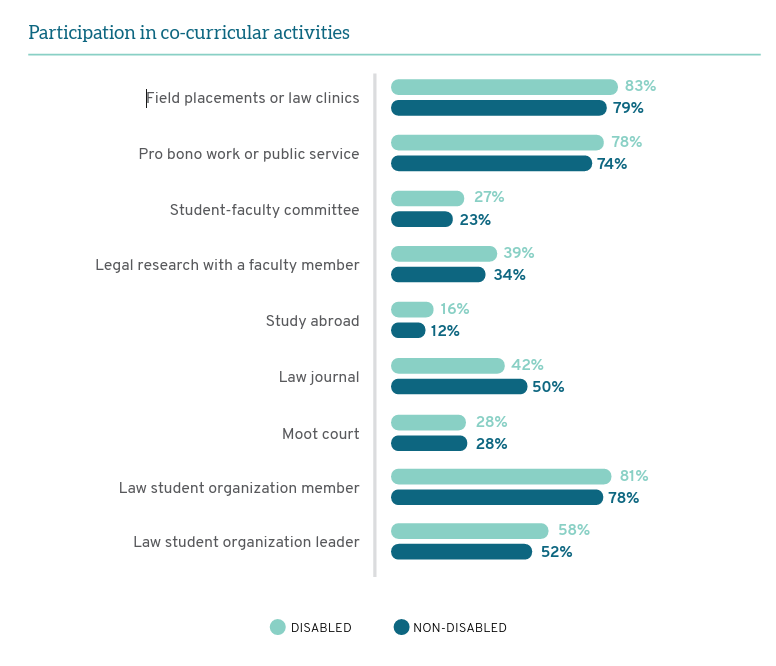
Co-curricular activities help students build practical skills, expand professional networks, and deepen their engagement with the legal community beyond the classroom. On average, students of all abilities spend about 4.4 hours per week engaging in co-curricular activities. Disabled law students are more likely than their non-disabled peers to participate or plan to participate in field placements or clinics (83% vs. 79%), pro bono work (78% vs. 74%), and faculty research projects (39% vs. 34%). Disabled students are also more likely than their non-disabled classmates to be leaders in law student organizations (58% vs. 52%) and members of student-faculty committees (27% vs. 23%). Participation is identical for both groups in moot court (28%), while disabled students are less likely to be members of a law journal (42% vs. 50%). Overall, the data suggest that disabled students are deeply involved in the broader law school community and seek out opportunities that enhance their education and professional development.
 Institutional Support
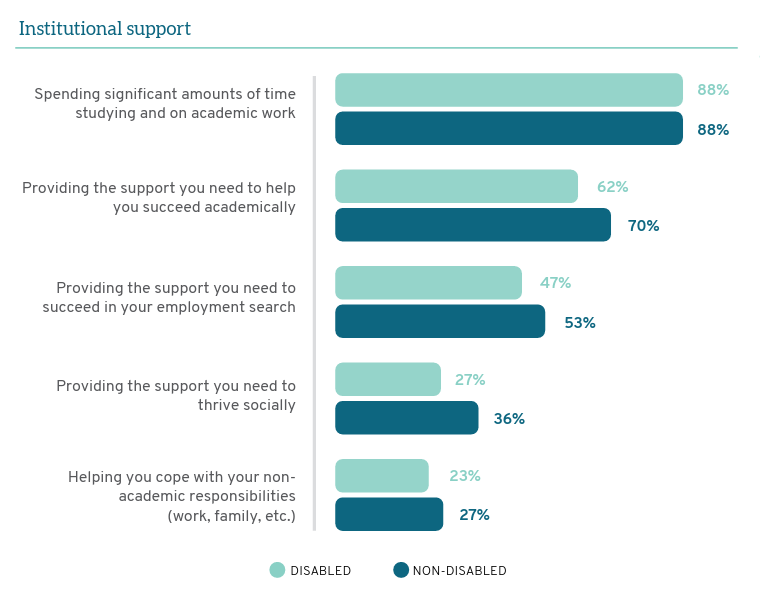
Law school is demanding, and institutional support can play a critical role in helping students navigate its academic and personal challenges. When asked how much their law school emphasizes various aspects of student success, student responses reveal important differences based on disability status. Both disabled and non-disabled students overwhelmingly say that their law schools emphasize the importance of intellectual effort, with 88% of each group agreeing “quite a bit” or “very much” that their school encourages spending significant time on academic work.
However, notable gaps emerge in areas of institutional support. Disabled students are less likely than their non-disabled peers to feel their school provides “quite a bit” or “very much” academic support (62% vs. 70%) or job search assistance (47% vs. 53%). Twice as many disabled students experience “very little” academic support (9.6%) compared to their non-disabled peers (4.8%). Even larger disparities appear in perceptions of social support and help with non-academic responsibilities. Only 27% of disabled students feel their school supports their social wellbeing (compared to 36% of non-disabled students). Similarly, just 23% of disabled law students say their school helps them manage outside responsibilities like work and family, compared to 27% of their non-disabled peers. While law schools demand equal levels of academic rigor, they fail to provide disabled students with necessary institutional support in key areas that affect their overall wellbeing and professional development.
Overall, the findings we have shared in this post and our last post present a clear and important message. Law students with disabilities are highly engaged in legal education, often even more than their non-disabled peers. They prepare extensively, participate actively in class, and involve themselves deeply in co-curricular opportunities that enrich their legal training. Yet this strong commitment exists alongside lower levels of satisfaction and weaker perceptions of institutional support. For law schools committed to fostering an inclusive and thriving learning environment, these results suggest the need to look beyond participation and examine how structures, policies, and campus climates shape the day-to-day experiences of students with disabilities. Strengthening academic, professional, and social support systems will be essential to ensuring that all students can fully benefit from their legal education. Recognizing disability as an important but often overlooked dimension of diversity is a key step toward building law schools that value and support the full range of student experiences.
For more information about law students with disabilities, please see our 2025 LSSSE annual report Disability in Law School.